During the month of June, Malin Arnell, Åsa Elzén and Annika Ruth Persson spent three weeks at the Bard Campus preparing for the opening reading / speech / performance Hostilities / Events / Inclusion / Assimilation / Disruptions and Beginnings for the group exhibition Anti-Establishment. It took place on and around the floor painting, Smoking Area and included four bags of soil, thirty satchels of yellow onions, a small white pyramid, a knife, and two different texts that were read aloud during the performance. With Invitation, YES! Association / Föreningen JA! handed over time and space to Annika Ruth Persson to do research for her literary project Hannah Arendt's 1940s, a non-biography in three parts (published in Swedish, 2014 by Kabusa Books) in the Hannah Arendt Collection at Bard College during a four-week period in October 2012. The fourth part, the Hannah Arendt Memorial Smoking Porch, is a proposal for a permanent work, to be installed at the Hannah Arendt Center, to commemorate Hannah Arendt. This fourth part was finally finalized in the fall of 2016, through the piece Space of Appearance (2016).
YES! Association / Föreningen JA!’s statement for SMOKING AREA (2012):
AN INSTITUTION IS AN INSTITUTION IS AN INSTITUTION IS AN INSTITUTION? – Hostilities / Events / Inclusion / Assimilation / Disruptions and Beginnings
An institution is the people who run it, but not only, it is also its legacy, its past and its aspirations for the future. It is full of living people, ghosts, and the ones not yet born. The institution becomes that which is negotiated between the living, not yet born, and dead. It is a site of contestation.
YES! Association / Föreningen JA! is an art collective, an institution, an art worker, a group of people working to overthrow the ruling system of heteronormative, patriarchal, racist, and capitalist power structures by putting into practice a structural redistribution of access to financial resources, space and time within the art scene.
Sometimes YES! Association / Föreningen JA! gets invited to other institutions. That invitation usually comes with conditions, hopes, and a set of rules. The hope is that something will get disrupted and this disruption is both celebrated and expected. But we are all pre-conditioned by the administrative formalities that organize the spaces of manoeuvre for bodies within institutions—to classify, categorize, normalize, and strive for efficiency, and somehow, everything suddenly slips back to business as usual. The tendency is so strong. And it often comes with good intentions.
A way of disrupting the institution is to claim the position of the in-between-spaces, insist on acting in there and from there. The in-between-spaces are the unruly ones, the willful ones, the contingent ones. But because they are situated outside legitimizing discourses they also runs the risk of becoming the non spaces, the invisible spaces, understood as simply awkward and impossible. Pariah position.
This is the moment that we have to resist the lure of assimilation. Because assimilation always means that the pariah becomes her own worst enemy. It is impossible to assimilate and at the same time refuse the hostility towards your own pariah group. If you oppose that hostility you break the assimilation and become exposed as pariah again. Thus, assimilation means that you take part in hostilities against yourself. The cost of assimilation is different, depending on how strong the hostility is against your pariah group at a particular time in a specific context. A strong drive for assimilation and inclusion in the institutions is related to economic benefits.
Here we are with our longing for equality and diversity, for another new beginning. Hostility pushing through our skin, from inside out, from outside in. Someone in the room (Judith Butler) wants to give us advice: Instead of striving to gain equality within an inherently unequal dominant order we must ”refuse its terms, to let the term itself wither, to starve it of its strength”. We stand up and speak: We are the people in the house. Dreams, unhappiness, rage are all over the architecture.
(Hannah Arendt later whispers from her grave: Don’t forget to smoke and to think in dialogue, then you will be able to forgive.)
SMOKING AREA (2012) consisted of the following works: Smoking Area (2012), floor painting, Hostilities / Events / Inclusion / Assimilation / Disruptions and Beginnings (2012), a reading / speech / performance, Invitation (2012), a month-long stay for writer and translator Annika Ruth Persson, Hannah Arendt Memorial Smoking Porch (completed in 2016), a commemorative project at Hannah Arendt Center, Bard College as part of the group exhibition Anti-Establishment (2012) curated by Johanna Burton at CCS Bard Galleries, Annandale-on-Hudson, NY.
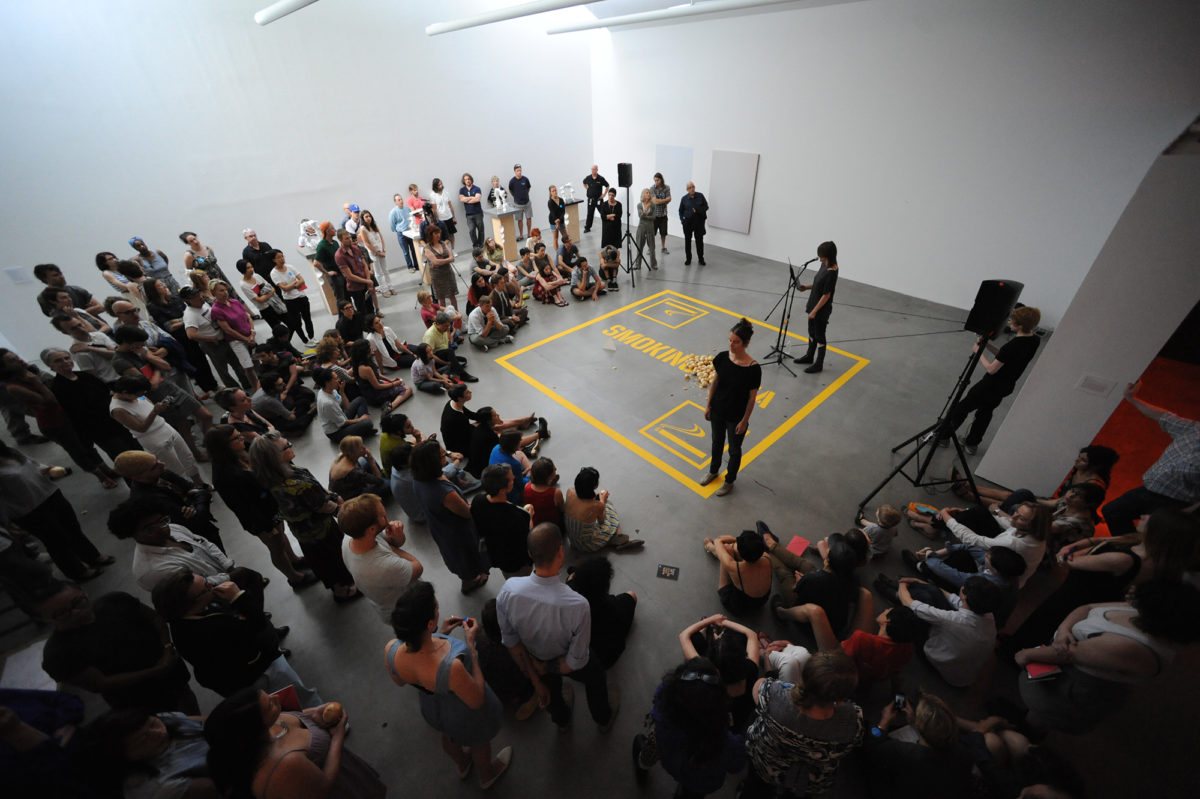
Hostilities / Events / Inclusion / Assimilation / Disruptions and Beginnings (2012), a reading / speech / performance with Malin Arnell, Åsa Elzén and Annika Ruth Persson. Photo: CCS Bard.